Why Do Young Adults Coreside with Their Parents?
Research summary · Acolin, Lin, and Wachter (2024)
Citation: Acolin, A., Lin, D., & Wachter, S. M. (2024). Why do young adults coreside with their parents? Real Estate Economics, 52(1), 7–44. https://doi.org/10.1111/1540-6229.12467

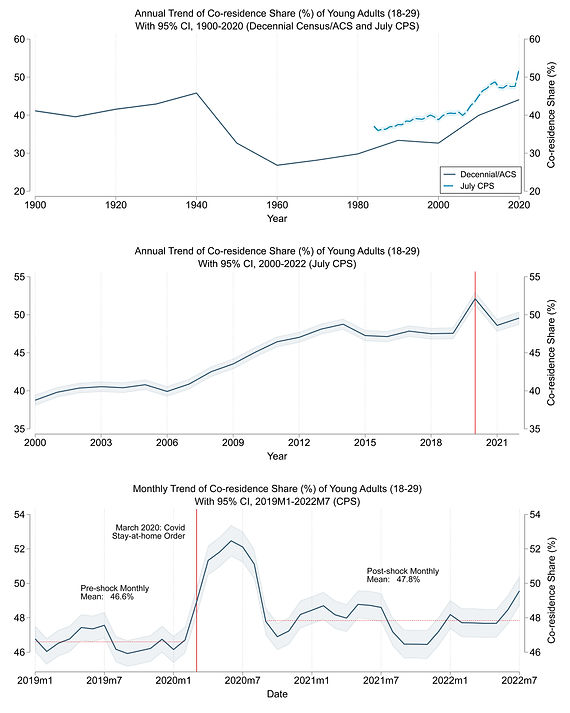
Young-Adult Coresidence at a Historic High since 1900
The coresidence share of young adults starts at 41% in 1900 and remains at this or a somewhat higher rate through 1940.
In the following two decades of post-World War II rapid growth, the coresidence share of young adults drops from 46% in 1940 to 27% in 1960, a period in which homeownership rapidly rises and then stabilizes from 1960 to 1990.
After 1960, the coresidence share increases every decade, except for a slight decrease during 1990–2000 when homeownership rises.
Since 2000, the coresidence share has increased from 39.9% to 49% as of March 2021. This is about twice the pace of the previous four decades.
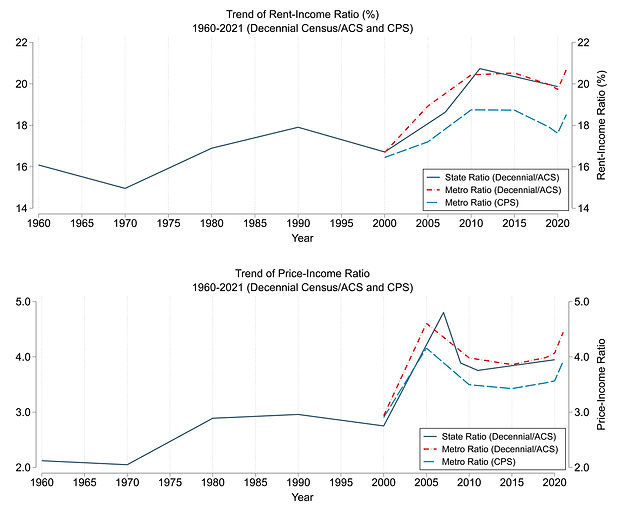
Housing Affordability at a Historic Low
Rent-income and price-income ratios rise from 1970 to 1990 before declining in the 1990s, a decade during which homeownership increases and the co-residence share decreases.
In 2000, measures of the housing-affordability burden begin increasing until their decline with the subprime recession of 2009, then rise again in 2010 and remain higher than at any point since 1960.
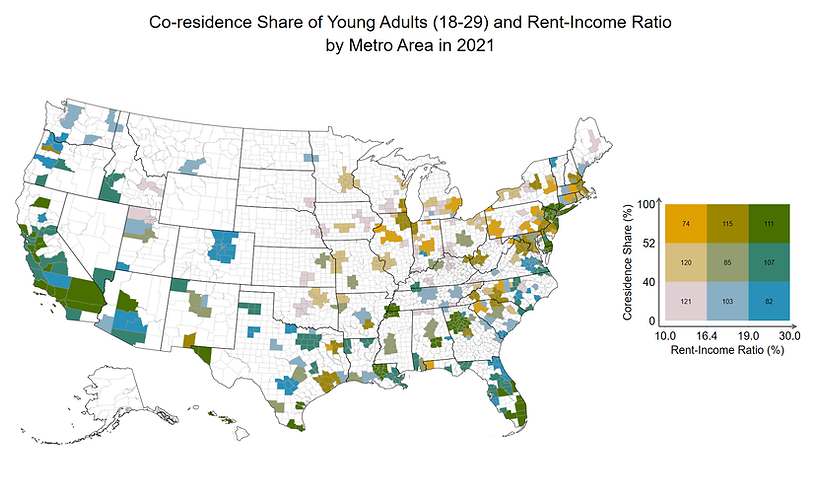
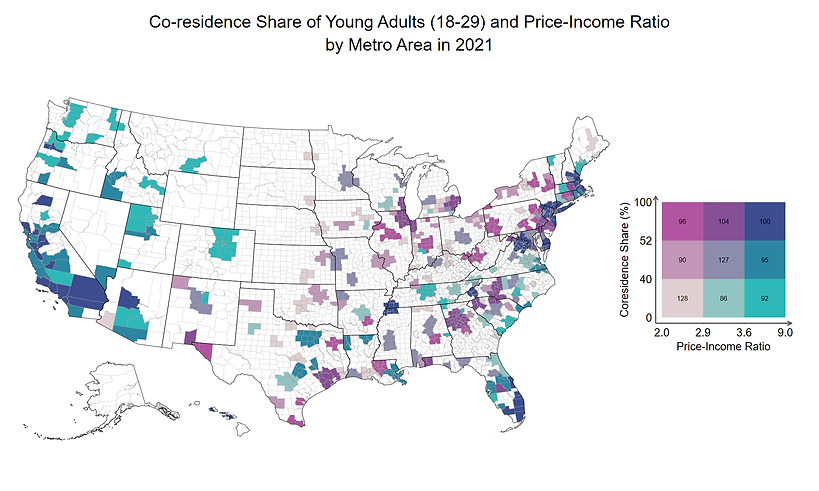
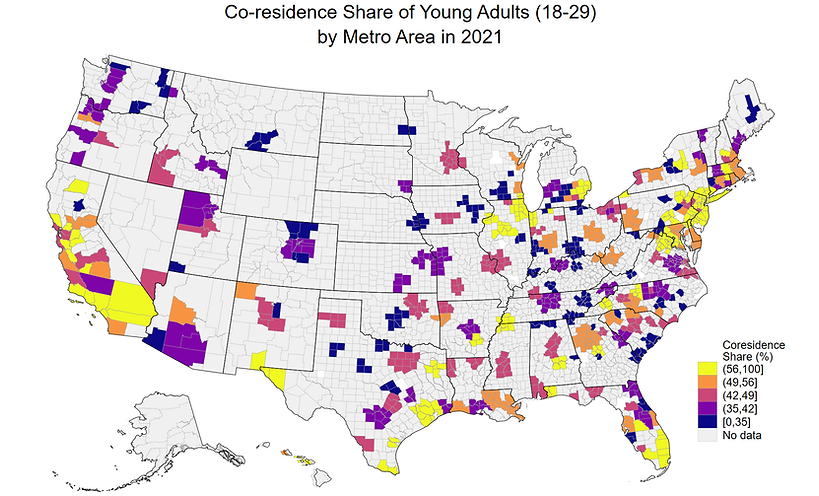
By accounting for the response of marriage and childbearing decisions to the decline in housing affordability in young adults’ co-residence choices, we attribute up to a quarter of the observed 9-percentage-point increase in the co-residence share between 2000 and 2021 to a decrease in housing affordability.
Coresidence Choices Depend Strongly on Population Groups
The decomposition of coresidence change by race group shows that increased coresidence among White young adults during 2000–2021 is mostly attributed to marriage and childbearing delays and decreased housing affordability.
In comparison, increased coresidence among minority young adults is attributed to these two factors as well as changes in employment, immigration, and educational attainment during the period.
Housing Affordability Becomes More Impactful on Coresidence Choices
The effect of affordability becomes more pronounced over time.
The rent-income model shows a local peak of the marginal effect in 2005, increasing again until 2015 and then flattening. In the price-income model, the coefficient increases from 2000 to 2015, then flattens as well.
The growing importance of affordability in the coresidence decision over time could reflect a potential increase in the metro dispersion of rent-income and price-income ratios.
Where Affordability Matters Most
The effects of the rent-income (price-income) ratio are stronger in the top quintiles of affordability measures, meaning that affordability is a more important factor in the coresidence decision in less affordable metros.
The finding of stronger affordability impacts in less affordable markets echoes the earlier finding of a more salient effect of affordability on co-residence in more recent years, reflecting the more binding nature of affordability in high-price and high-rent metros in the years after the Great Recession.